×
× 




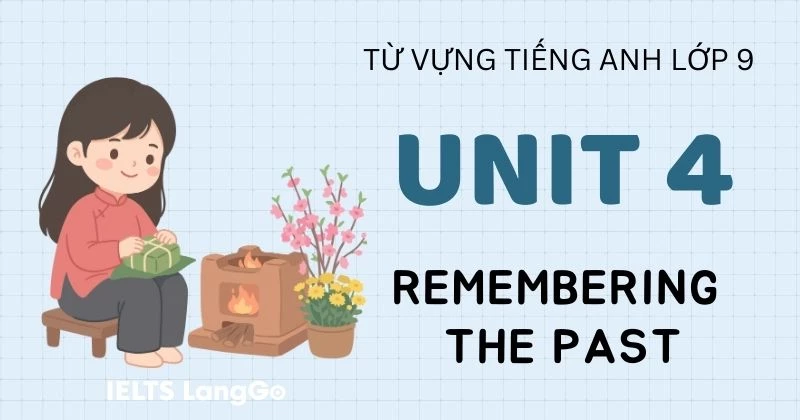
Trong Unit 4 lớp 9 sách Global Success về chủ đề Remembering the Past (Nhớ về quá khứ), các bạn học sinh sẽ được trau dồi vốn từ vựng về lịch sử, truyền thống để mô tả và thảo luận về cuộc sống trong quá khứ.
Bài viết này sẽ tổng hợp đầy đủ từ vựng Tiếng Anh Unit 4 lớp 9 kèm ví dụ minh họa cụ thể cùng các cụm từ thông dụng và bài tập thực hành để học sinh có thể ghi nhớ và vận dụng từ vựng hiệu quả trong quá trình học tập.
Trong phần này, IELTS LangGo sẽ tổng hợp các từ vựng quan trọng trong Unit 4 kèm phiên âm, ý nghĩa và ví dụ giúp các bạn học sinh dễ dàng ghi nhớ và sử dụng thành thạo.
1. ancient (adj) /ˈeɪnʃənt/: cổ đại, lâu đời
Ví dụ: Vietnam has many ancient temples and pagodas. (Việt Nam có nhiều đền chùa cổ kính.)
2. anniversary (n) /ˌænɪˈvɜːsəri/: ngày kỷ niệm, lễ kỷ niệm
Ví dụ: We celebrate the anniversary of our country's independence every year. (Chúng ta kỷ niệm ngày độc lập của đất nước mỗi năm.)
3. barefoot (adj, adv) /ˈbeəfʊt/: chân trần
Ví dụ: In the past, many children went to school barefoot. (Ngày xưa, nhiều trẻ em đi học chân trần.)
4. basic (adj) /ˈbeɪsɪk/: cơ bản
Ví dụ: People in the past only had basic facilities. (Người dân ngày xưa chỉ có những tiện nghi cơ bản.)
5. castle (n) /ˈkɑːsl/: lâu đài
Ví dụ: There are many beautiful castles in Europe. (Có nhiều lâu đài đẹp ở châu Âu.)
6. communal (adj) /kəˈmjuːnl/: dùng chung, thuộc cộng đồng
Ví dụ: The communal house is an important place in Vietnamese villages. (Đình làng là nơi quan trọng trong các làng xã Việt Nam.)
7. complex (n) /ˈkɒmpleks/: khu phức hợp, quần thể
Ví dụ: The Imperial Citadel of Thang Long is a complex of ancient structures. (Hoàng thành Thăng Long là quần thể các công trình kiến trúc cổ.)
8. deep-rooted (adj) /ˌdiːp ˈruːtɪd/: lâu đời, ăn sâu bén rễ
Ví dụ: Respect for elders is a deep-rooted tradition in Vietnamese culture. (Tôn trọng người lớn tuổi là truyền thống lâu đời trong văn hóa Việt Nam.)
9. face to face (adv) /ˌfeɪs tə ˈfeɪs/: trực tiếp, trực diện
Ví dụ: In the past, people communicated face to face more often. (Ngày xưa, mọi người giao tiếp trực tiếp thường xuyên hơn.)
10. fish and chips (n) /ˌfɪʃ ən ˈtʃɪps/: món cá và khoai tây rán (món ăn truyền thống của người Anh)
Ví dụ: Fish and chips is a traditional British dish. (Cá và khoai tây chiên là món ăn truyền thống của người Anh.)
11. found (v) /faʊnd/: thành lập
Ví dụ: Hanoi was founded over 1000 years ago. (Hà Nội được thành lập hơn 1000 năm trước.)
12. generation (n) /ˌdʒenəˈreɪʃn/: thế hệ
Ví dụ: Traditional values are passed down from generation to generation. (Các giá trị truyền thống được truyền từ thế hệ này sang thế hệ khác.)
13. monument (n) /ˈmɒnjumənt/: tượng đài
Ví dụ: The Statue of Liberty is a famous monument in New York. (Tượng Nữ thần Tự do là tượng đài nổi tiếng ở New York.)
14. observe (v) /əbˈzɜːv/: duy trì, tuân theo
Ví dụ: Vietnamese people observe many traditional customs during Tet. (Người Việt Nam duy trì nhiều phong tục truyền thống trong dịp Tết.)
15. occupied (adj) /ˈɒkjupaɪd/: có người ở
Ví dụ: The castle was occupied by the royal family in the past. (Lâu đài từng có hoàng gia sinh sống trong quá khứ.)
16. occupy (v) /ˈɒkjupaɪ/: chiếm giữ
Ví dụ: Foreign troops occupied the country for many years. (Quân đội nước ngoài đã chiếm đóng đất nước trong nhiều năm.)
17. promote (v) /prəˈməʊt/: thúc đẩy
Ví dụ: The government promotes cultural heritage preservation. (Chính phủ thúc đẩy việc bảo tồn di sản văn hóa.)
18. recognise (v) /ˈrekəɡnaɪz/: công nhận
Ví dụ: UNESCO recognised Ha Long Bay as a World Heritage Site. (UNESCO công nhận Vịnh Hạ Long là Di sản Thế giới.)
19. religious (adj) /rɪˈlɪdʒəs/: (thuộc) tôn giáo
Ví dụ: Many religious festivals are celebrated in Vietnam. (Nhiều lễ hội tôn giáo được tổ chức ở Việt Nam.)
20. structure (n) /ˈstrʌktʃə/: cấu trúc
Ví dụ: The ancient structure has been well preserved. (Cấu trúc kiến trúc cổ đã được bảo quản tốt.)
21. takeaway (n) /ˈteɪkəweɪ/: đồ ăn bán sẵn (để mang về)
Ví dụ: In modern times, people often buy takeaway food. (Ngày nay, mọi người thường mua đồ ăn mang về.)
Bên cạnh các từ vựng đơn lẻ, việc học các cụm từ (collocations) sẽ giúp các bạn học sinh diễn đạt tự nhiên và chính xác hơn.
Dưới đây là các cụm từ thông dụng về chủ đề Remembering the past, các bạn cùng học nhé.
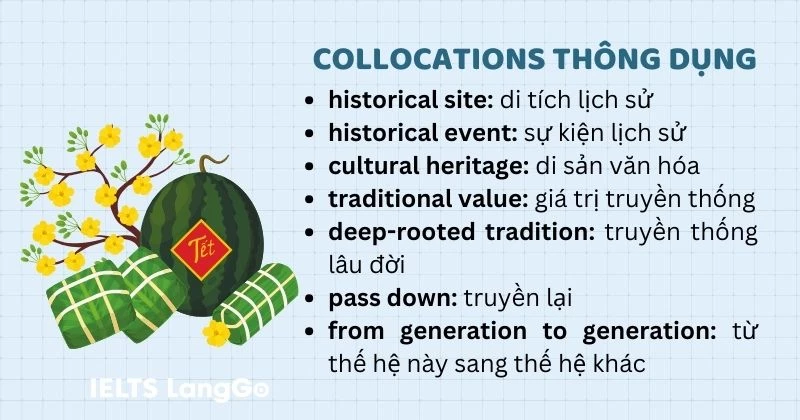
Ví dụ: We were able to save the ancient monument. (Chúng tôi đã có thể cứu tượng đài cổ.)
Ví dụ: Dinh Bang Communal House is a national historic site. (Đình Bảng là di tích lịch sử quốc gia.)
Ví dụ: The best way to preserve our cultural heritage is to share it with others. (Cách tốt nhất để bảo tồn di sản văn hóa là chia sẻ nó với người khác.)
Ví dụ: Angkor Wat is a World Heritage Site. (Angkor Wat là Di sản Thế giới.)
Ví dụ: Angkor Wat is a temple complex. (Angkor Wat là quần thể đền chùa.)
Ví dụ: Vietnamese people take great pride in their culture which has been well preserved for thousands of years. (Người Việt Nam rất tự hào về nền văn hóa đã được bảo tồn tốt hàng nghìn năm.)
Ví dụ: They keep their traditions alive and pass them down to the next generation. (Họ giữ truyền thống sống động và truyền lại cho thế hệ tiếp theo.)
Ví dụ: Festivals are handed down from one generation to the next. (Các lễ hội được truyền từ thế hệ này sang thế hệ khác.)
Ví dụ: Ancestor worship is a deep-rooted tradition in Vietnam. (Thờ cúng tổ tiên là truyền thống lâu đời ở Việt Nam.)
Ví dụ: Young people should respect traditional values. (Giới trẻ nên tôn trọng các giá trị truyền thống.)
Ví dụ: It's our duty to keep our traditions alive for future generations. (Đó là nhiệm vụ của chúng ta để giữ gìn truyền thống cho thế hệ tương lai.)
Ví dụ: We celebrate each family member's birthday every year. (Chúng tôi kỷ niệm sinh nhật mỗi thành viên trong gia đình hàng năm.)
Ví dụ: They celebrate their death anniversaries every year. (Họ tổ chức lễ giỗ hàng năm.)
Ví dụ: Vietnam gained independence in 1945. (Việt Nam giành độc lập năm 1945.)
Ví dụ: The August Revolution of 1945 is a significant historical event for Vietnamese people. (Cách mạng tháng Tám 1945 là sự kiện lịch sử có ý nghĩa quan trọng với người Việt Nam.)
Ví dụ: In the past, people communicated face to face more often. (Người xưa giao tiếp trực tiếp thường xuyên hơn.)
Ví dụ: Many poor children walked barefoot to school. (Nhiều trẻ em nghèo đi học chân trần.)
Ví dụ: Villages only had basic facilities in the past. (Các làng mạc chỉ có tiện nghi cơ bản ngày xưa.)
Ví dụ: The communal house has a significant meaning in the Bahnar community. (Đình làng có ý nghĩa quan trọng trong cộng đồng người Bahnar.)
Ví dụ: Some ethnic groups still maintain their traditional way of life. (Một số dân tộc vẫn duy trì lối sống truyền thống.)
Ví dụ: Banh Chung is a traditional dish originated in 6th Hung King's time. (Bánh chưng là món ăn truyền thống có nguồn gốc từ thời vua Hùng thứ 6.)
Ví dụ: The basic ingredients of the dish are fried fish served with chips. (Nguyên liệu cơ bản của món ăn là cá chiên ăn kèm khoai tây chiên.)
Ví dụ: In keeping with tradition, we cook five-colour sticky rice on the first day of a lunar month. (Theo truyền thống, chúng tôi nấu xôi ngũ sắc vào ngày đầu tháng âm lịch.)
Ví dụ: They worship their ancestors and celebrate their death anniversaries. (Họ thờ cúng tổ tiên và tổ chức lễ giỗ.)
Để củng cố và kiểm tra việc ghi nhớ từ vựng, các bạn hãy thực hành làm các bài tập vận dụng dưới đây nhé.
ancient - anniversary - castle - communal - complex - generation - monument - religious - heritage - preserve
1. Windsor _____________ was built about a thousand years ago.
2. This year marks the 50th _____________ of our school.
3. Angkor Wat is an _____________ temple built in the 12th century.
4. The Imperial Citadel is a large historical _____________.
5. Traditional values are passed from _____________ to generation.
6. The _____________ house is where villagers gather for meetings.
7. The _____________ stands in the center of the square dedicated to the people killed in the war.
8. Angkor Wat is the largest _____________ monument in the world.
9. We need to _____________ our cultural traditions for future generations.
10. Thanks to preservation efforts, we know a lot about our _____________ and life in the past.
Đáp án:
1. Castle
2. anniversary
3. ancient
4. complex
5. generation
6. communal
7. monument
8. religious
9. preserve
10. heritage
World Heritage Site - face to face - cultural heritage - from generation to generation - death anniversaries - deep-rooted traditions - keep traditions alive
1. Angkor Wat was recognised as a _____________ by UNESCO.
2. In the past, people communicated _____________ more often than now.
3. Vietnam has rich _____________ that needs to be preserved.
4. These customs have been passed down _____________.
5. Vietnamese families celebrate _____________ every year to show gratitude to their ancestors.
6. English cuisine is among the _____________ that English people are proud of.
7. It's our duty to _____________ for future generations.
Đáp án:
1. World Heritage Site
2. face to face
3. cultural heritage
4. from generation to generation
5. death anniversaries
6. deep-rooted traditions
7. keep traditions alive
1. UNESCO _____________ many Vietnamese sites as World Heritage Sites.
Apromoted
B. recognised
C. occupied
D. founded
2. English cuisine is among the _____________ traditions that English people are proud to keep alive.
A.deep-rooted
B. barefoot
C. basic
D. occupied
3. The fire of London destroyed thousands of old _____________.
A. generations
B. anniversaries
C. structures
D. takeaways
4. This complex of buildings was _____________ by foreign troops during the war.
A. founded
B. occupied
C. promoted
D. observed
5. Fish and chips is now a common _____________ in the United Kingdom.
A. structure
B. heritage
C. monument
D. takeaway
Đáp án:
1. B
2. A
3. C
4. B
5. D
Qua bài viết này, chúng ta đã cùng nhau khám phá toàn bộ từ vựng Unit 4 lớp 9 chủ đề Remembering the Past sách Global Success cùng với các cụm từ thông dụng và bài tập thực hành.
Các bạn học sinh hãy dành thời gian ôn tập từ vựng thường xuyên, làm đầy đủ các bài tập thực hành và cố gắng sử dụng những từ vựng này trong giao tiếp hàng ngày để ghi nhớ lâu dài và sử dụng thành thạo hơn nhé.








ĐẶT LỊCH TƯ VẤN MIỄN PHÍ LỘ TRÌNH Săn ƯU ĐÃI lên tới 12.000.000đ